

2026 Outlook: What Universities and Workforce Programs Will Actually Prioritize
“Nearly 70% of employers say graduates are not adequately prepared for the workforce, even as institutions expand career-oriented offerings.”
(Georgetown Center on Education and the Workforce, After Everything)
Higher education leaders are entering the 2026 planning cycle with fewer illusions and higher expectations. Over the last decade, institutions have experimented with new program models, digital delivery, employer partnerships, and alternative credentials. Some initiatives delivered meaningful results; many stalled under the weight of competing priorities, constrained budgets, and unclear ownership.
What feels different now is not simply urgency; it is selectivity. Universities and workforce programs are no longer trying to be everything to everyone. Instead, leadership teams are narrowing focus, aligning resources more deliberately, and asking harder questions about relevance, sustainability, and outcomes.
This article examines what universities and workforce programs will actually prioritize in 2026, not aspirationally, but operationally, and how campus leaders can prepare for those shifts with confidence.
From Broad Strategy to Focused Execution
For years, workforce alignment has been a staple of strategic plans. Yet research from the Georgetown Center on Education and the Workforce highlights a persistent disconnect between credentials earned and labor market needs, particularly in fast-changing sectors (After Everything, 2023). This gap has consequences: enrollment volatility, employer skepticism, and growing pressure from boards to demonstrate return on investment.
By 2026, workforce alignment is no longer treated as a directional goal. It is becoming a baseline expectation.
Institutions are shifting from:
- High-level statements about employability to
- Program-level accountability for outcomes
This shift is visible in how universities define success, allocate funding, and evaluate leadership performance.
Priority #1: Workforce Alignment That Is Measured, Not Assumed
Workforce alignment in 2026 looks less like marketing language and more like operational discipline. Institutions increasingly rely on labor market analytics platforms such as Lightcast (formerly Emsi Burning Glass) to ground decisions in regional and national demand data (Lightcast, Labor Market Alignment Research).
Key characteristics of this shift include:
- Demand-informed program design
Programs are increasingly mapped to specific job families, skills clusters, and employer needs, especially in healthcare, technology, advanced manufacturing, and business services.
- Employer engagement with real influence
Advisory boards are expected to shape curriculum decisions, not merely validate them after the fact. - Outcome transparency
Placement rates, wage outcomes, and time-to-employment are moving from internal reports to external-facing metrics.
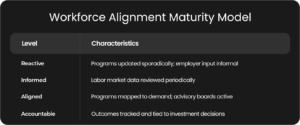
Institutions operating at the “aligned” or “accountable” levels are better positioned to justify investment, sunset underperforming programs, and earn employer trust.
Priority #2: Program Portfolios That Are Smaller, but Stronger
One of the most consequential shifts underway is portfolio discipline. Rather than expanding offerings broadly, institutions are pruning and strengthening.
NACUBO reports that financial sustainability has emerged as a top-three concern for higher education executives, driven by enrollment uncertainty and rising delivery costs (NACUBO, Financial Sustainability Report, 2024). As a result, leaders are asking tougher questions:
- Which programs consistently meet enrollment and outcome targets?
- Which requires ongoing subsidy with limited strategic value?
- Which could be redesigned into more modular or stackable formats?
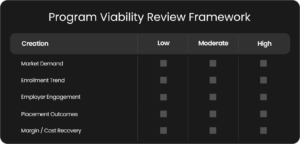
Programs that consistently score low across dimensions are increasingly paused, merged, or restructured, often freeing resources for higher-impact initiatives.
Priority #3: Growth of Non-Degree and Workforce Credentials
While degrees remain central to institutional identity, non-degree credentials are no longer peripheral. EDUCAUSE and HolonIQ both note continued growth in short-term credentials driven by adult learners seeking rapid skill acquisition (EDUCAUSE Horizon Report, 2024; HolonIQ, Global Education Outlook).
Key drivers include:
- Employer demand for skills-based hiring
- Learners seeking lower-cost, lower-risk pathways
- Institutions looking for faster time-to-market
Importantly, successful institutions are not treating non-degree programs as separate silos. Instead, they are designing stackable pathways that allow learners to move between certificates and degrees.
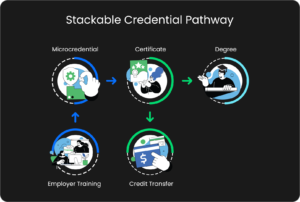
This model increases flexibility for learners while preserving academic coherence.
Priority #4: Budgeting That Follows Outcomes
In 2026, budgeting conversations are increasingly outcome-driven. Rather than distributing resources evenly or historically, leaders are aligning funding with performance indicators.
According to NACUBO, institutions that link budget decisions to measurable outcomes report stronger governance confidence and clearer strategic alignment (NACUBO, 2024).
Outcome-linked budgeting includes:
- Increased investment in programs with strong placement data
- Reduced subsidy for persistently underperforming offerings
- Shared services across workforce, online, and continuing education units
This approach also supports clearer conversations with boards and state systems.
Priority #5: Technology That Supports Decision-Making, Not Just Delivery
Technology continues to play a critical role, but its purpose is evolving. EDUCAUSE notes a growing emphasis on analytics and decision-support tools rather than isolated platforms (EDUCAUSE Horizon Report, 2024).
Institutions are prioritizing:
- Integrated dashboards for enrollment, completion, and placement
- LMS environments optimized for adult and hybrid learners
- Analytics that inform program review and resource allocation
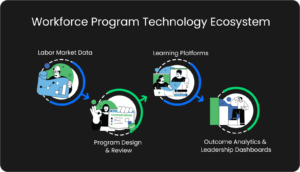
Technology investments increasingly require a clear line of sight to outcomes.
What This Means for Campus Leaders
The institutions that succeed in 2026 will not be those that chase every trend, but those that make intentional trade-offs. Leaders are expected to say “no” more often, supported by data and aligned governance.
Key leadership implications:
- Program decisions become evidence-based, not political
- Employer relationships deepen, but require sustained engagement
- Workforce units gain strategic visibility rather than operating at the margins
How Academian Helps Institutions Execute These Priorities
As universities and workforce programs move from broad strategy to focused execution, capacity and clarity become critical. Academian partners with institutions to operationalize workforce alignment and outcome-driven decision-making without long-term vendor lock-in.
Academian supports institutions by:
- Designing demand-aligned programs and credentials
Translating labor market data and employer input into job-mapped curricula, stackable credentials, and modular pathways that connect non-degree programs to degrees.
- Strengthening program portfolios with evidence
Supporting program viability analysis, redesign, and rationalization to help institutions invest in offerings with clear demand, outcomes, and sustainability.
- Accelerating time-to-market for workforce offerings
Rapid development and refresh of online, hybrid, and professional programs, enabling institutions to launch and iterate faster in response to changing employer needs.
- Building credible assessment and outcome frameworks
Designing skills-based assessments, credential validation models, and analytics-ready structures that demonstrate job relevance, learner mastery, and return on investment.
- Modernizing digital courseware at scale
End-to-end online course design, content transformation, accessibility compliance, and large-scale updates across LMS environments.
- Enabling responsible use of AI in learning and operations
Human-in-the-loop AI to support content creation, assessment development, and analytics, aligned with institutional governance, academic integrity, and risk requirements.
Academian works as a fee-for-service partner, allowing institutions to retain full control of academic strategy, data, and intellectual property while gaining the execution capacity needed to turn priorities into outcomes.
Closing Perspective
Success in 2026 will belong to institutions that move from intention to execution, those that base program decisions on real data, prioritize measurable outcomes, and engage employers strategically. Take the first step toward disciplined, demand-driven program management by reviewing a single program today.
To explore how Academian can help your institution align offerings, track outcomes, and strengthen workforce relevance, visit Academian.com.
More Articles for you